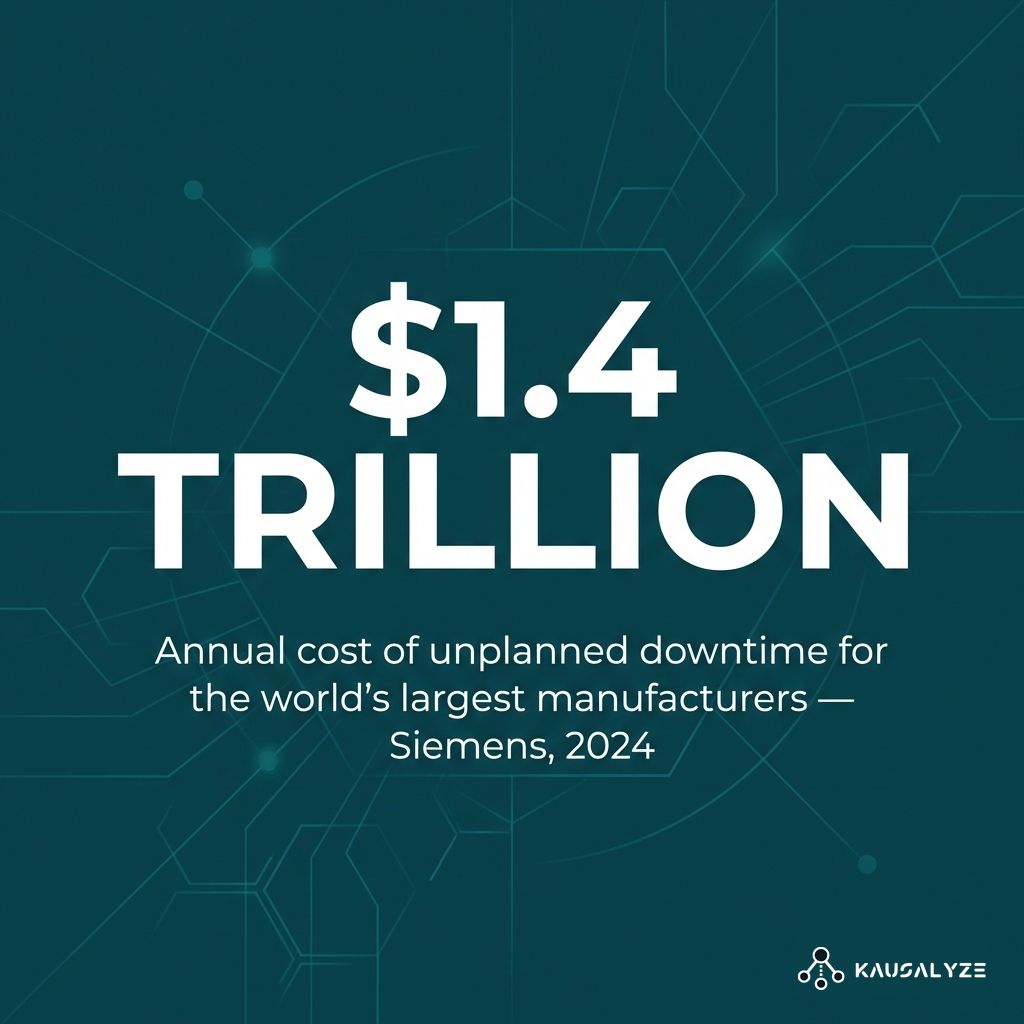
Kausalyze founder and CEO, Louis Allen, recently reflected on why unplanned downtime still costs the world's largest manufacturers $1.4 trillion a year (Siemens, 2024) despite considerable investment in AI and predictive maintenance tools.
"The problem isn't a lack of data. It's how that data is analysed. Most AI used in manufacturing today is built on correlation. These systems detect patterns and predict that something might fail - but they rarely explain why.
That creates a real problem on the plant floor.
Black-box models generate alerts. But they leave engineers asking the most important question: what should we actually do about it?
At Kausalyze, we take a different approach. Instead of correlation, we use causation.
We don't just predict equipment or process failures. We explain why they happen and what operational action will prevent them.
Because in complex industrial systems, failures don't happen statistically; they happen physically.
Understanding physical causal relationships is the key to moving from prediction to prevention. Because the future of manufacturing doesn’t belong to those who predict failure - it belongs to those who prevent it."
Louis's insights highlight that without understanding cause, even the most advanced AI struggles to drive real operational change.
Join the discussion
Share a question or perspective on this article.